Tactical Effectiveness: the four gauges, decoded
FM27’s most important new system is not a role or a formation. It is feedback. Tactical Effectiveness tells you whether the plan is landing — and where to fix the disconnect.
On this page
What Tactical Effectiveness is in FM27
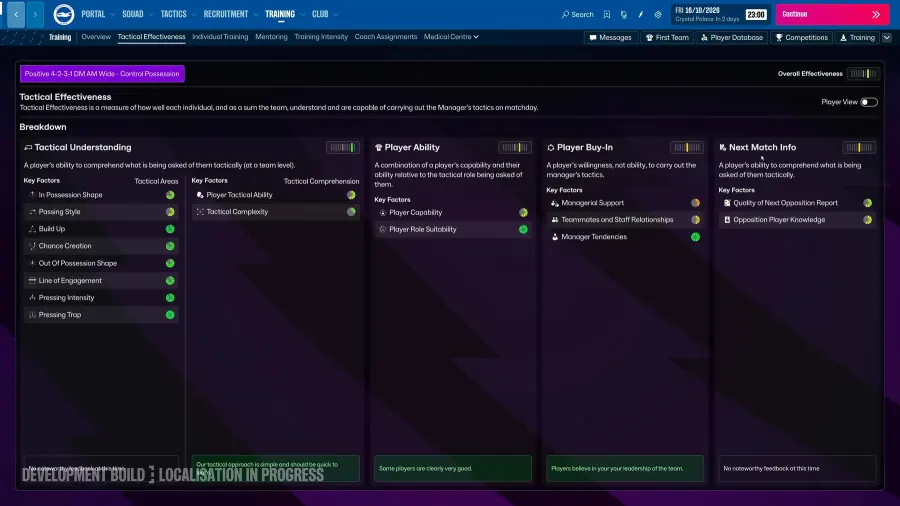
Tactical Effectiveness builds on the old tactical familiarity concept, but it is broader. Instead of asking only whether your players know the formation, FM27 asks whether they understand it, have the ability to execute it, believe in it and have the information needed for the next opponent.
The gauges are visible in the tactics area and feed into training and recruitment. That makes the system a connective layer rather than a hidden modifier. If your new signing is a poor fit, you should be able to see why before he has played ten matches. If your tactical plan is too detailed for a League Two squad, the feedback should point to complexity, not just form.
The four Tactical Effectiveness gauges
1. Tactical Understanding
This is the learning side: how well the squad knows the shape, roles, instructions and pressing triggers. It is influenced by time, training focus, familiarity with the tactic, player adaptability and the complexity of the plan. A newly installed tactic will usually start low, especially if you change shape, mentality and several player instructions at once.
What to watch: if understanding stays low after several weeks, the plan may be too complex or the training focus may not match the tactic. Check that your sessions actually rehearse the behaviours you selected.
2. Player Ability
Ability is not just current ability. It is the fit between your tactical demands and the attributes in the roles. A high-pressing system needs stamina and work rate. A possession system needs composure, passing and first touch under pressure. A low block needs concentration, positioning and aerial strength in the spine.
What to watch: a strong squad can still show a weak ability gauge if you are asking the wrong players to do the wrong jobs. A striker with elite finishing but poor link play may not suit a False Nine role, even if his star rating is high.
3. Player Buy In
Buy-in is the human dimension. Players need to accept the plan, their role and the manager’s decisions. Squad dynamics, morale, recent results, playing time, promises and individual conversations all feed the environment. A new captain with low influence, a public fallout or a sudden change in style can reduce belief even when the tactic is logically sound.
What to watch: if the other three gauges look healthy and buy-in is low, think about the dressing room rather than the whiteboard. A team meeting, a clearer role explanation or a change in leadership can do more than another tactical session.
4. Next Match Information
This gauge reflects preparation for the specific opponent: scouting knowledge, tactical planning, familiarity with their threats and the quality of the information available to your players. It is where opposition instructions and match preparation earn their place.
What to watch: a tactic can be well understood and still have a poor next-match gauge if you have not prepared for the opponent’s shape. Watch the scout report, train the relevant behaviour and avoid overloading the plan with contradictory instructions.
How to improve each gauge
| Gauge | Practical action | Warning sign |
|---|---|---|
| Tactical Understanding | Train the specific behaviour, reduce instruction volume, keep the shape stable for several weeks. | Players look unsure of their starting positions or the press trigger. |
| Player Ability | Recruit for the role, not the reputation. Check key attributes in the scout report and use simpler duties for weaker players. | A high-rated player consistently loses his duel or cannot complete the role’s basic pass. |
| Player Buy In | Manage squad dynamics, keep promises realistic, explain roles and protect confidence after defeats. | Body language is poor, team meetings are ignored or influential players are unsettled. |
| Next Match Information | Scout the opponent, set clear opposition instructions, rehearse the plan in match preparation. | You are surprised by the opposition shape or repeatedly exposed by the same pattern. |
The common thread is patience. The system is designed to reward a coherent plan that is trained and explained, not a tactic that changes every time a result goes wrong.
Tactical Complexity: the trade-off
Complexity measures the volume of team, player and opposition instructions. It is not a difficulty setting. It is a risk profile. A detailed system can create more control and a higher ceiling, but it asks more of the players and takes longer to learn. A simple system can deliver immediate clarity and then be found out.
The practical rule is to match complexity to context:
- Elite squad, stable leaders, full pre-season: you can afford a detailed press with several player instructions.
- Mid-table squad, new manager, short pre-season: start with a clear shape and a small number of instructions.
- Lower league, limited technical ability: prioritise simple duties, a compact block and direct patterns over elaborate possession triggers.
- Injury crisis or fixture congestion: reduce complexity even if the team knows the system. Tired players make worse decisions.
Complexity check: a planning tool
This is an editorial planning aid, not an in-game calculation. Use it to pressure-test whether your instruction load matches the squad in front of you.
Six instructions is a manageable load for a strong squad, but keep an eye on Tactical Understanding during the first month.
Recruitment impact: buy for execution, not reputation
FM27 adds Tactical Effectiveness data to scout reports. That changes the recruitment question. Instead of asking only “is this player good?”, ask “is he good at the job this tactic needs, in this league, at this point in the season?”
A technically excellent playmaker who lacks the work rate for your press may reduce the effectiveness of the whole unit. A less glamorous midfielder who reads the game and accepts the defensive brief may raise it. That does not mean you should only sign role players; it means the star signing has to fit the plan or the plan has to change.
Use our wonderkid database to compare young profiles, and read the transfer guide before committing to a marquee signing.
Matchday decisions: adapt without panicking
Tactical Effectiveness is not a permanent score. It moves with new instructions, personnel, morale and opponent information. During a match, use the dugout feedback and Tactical Tweaks to solve the most obvious problem. A lower effectiveness gauge late in a game may simply mean tired players are struggling with a demanding plan.
- If the team looks disconnected, reduce complexity instead of adding a new instruction.
- If one player is repeatedly out of position, check his role suitability and instruction load.
- If the press has stopped working, lower the block or change the trigger rather than shouting “more”.
- If you are protecting a lead, simplify the plan and protect the central lane.
Common Tactical Effectiveness mistakes
- Chasing the meta on day one. A copied tactic has no relationship with your squad’s ability or understanding.
- Changing the whole system after one defeat. This resets learning and makes diagnosis impossible.
- Ignoring buy-in. Tactics are executed by people, not role names.
- Overloading opposition instructions. More instructions can create confusion rather than control.
- Treating low effectiveness as a bug. It is often the game telling you the plan is ahead of the squad.
Tactical Effectiveness FAQ
What are the four Tactical Effectiveness gauges in FM27?
The four areas are Tactical Understanding, Player Ability, Player Buy In and Next Match Information. Together they indicate how well equipped your squad is to execute the tactical plan.
Is low Tactical Effectiveness a bug?
No. It is feedback. A new tactic, a group of new signings or a complex instruction set can all lower effectiveness while the squad adapts. Give the team time and simplify the plan if results are suffering.
Does Tactical Complexity always need to be low?
No. Complexity has a higher ceiling if your players can handle it. Elite squads can absorb detailed instructions; lower-league squads are more likely to struggle. The right level depends on ability, understanding and the time you have to train it.
How can I raise Player Buy In?
Use the squad dynamics and team meeting tools, keep promises realistic, explain decisions, avoid unnecessary squad churn and give important players a role they believe in. Tactical buy-in is connected to the human side of the save.
Sources
- Sports Interactive — FM27 Training & Tactical EffectivenessOfficial deep dive, 9 October 2026.
- Sports Interactive — FM27 key featuresOfficial feature hub.
Field notes
This guide is based on official FM27 information and our own analysis of the systems shown so far. Ratings and in-game examples from the Launch Preview can change before launch. Last checked 31 October 2026.